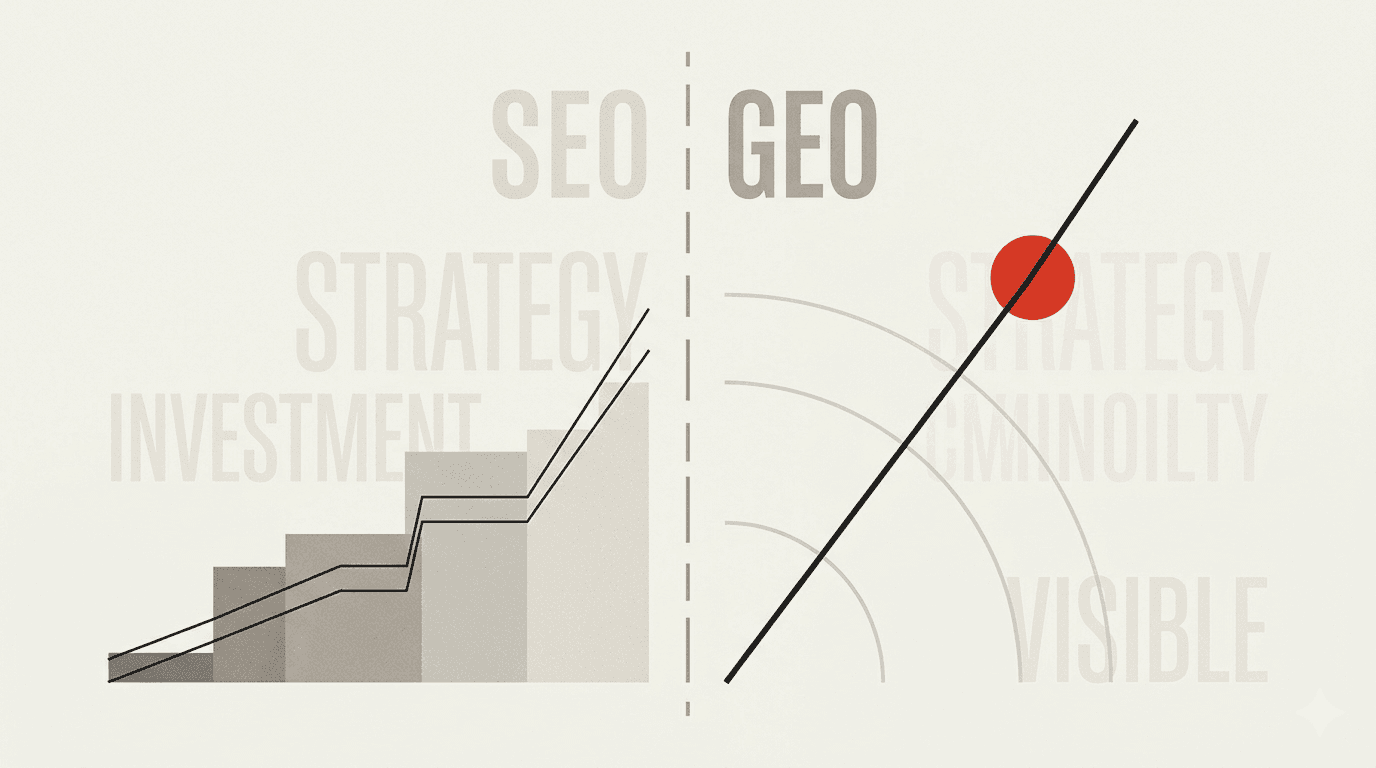
You've been optimizing your site for Google for years. You have your keywords, your backlinks, your Core Web Vitals. And it works, or at least, it used to.
Today, a new reality is emerging: a growing share of searches no longer go through Google in the same way. ChatGPT, Perplexity, Gemini, Claude... these AIs answer your potential clients' questions directly. And if your site isn't cited in those answers, you simply don't exist.
That's where GEO: Generative Engine Optimization comes in.
SEO: optimizing for traditional search engines
SEO (Search Engine Optimization) means optimizing your site to appear in Google, Bing, and other search engine results. The main levers are:
- Keywords: identifying what your clients search for and precisely answering those queries.
- Technical: loading speed, code structure, proper markup (title tags, meta descriptions, heading tags...).
- Authority: earning inbound links from recognized sites (backlinks).
- Content: regularly publishing relevant, in-depth, well-structured content.
The goal of SEO is to appear on page one, ideally in the top 3 results, for strategic queries relevant to your business.
GEO: optimizing for generative AI
GEO has a different goal: to be cited as a trusted source by generative AIs when they answer your potential clients' questions.
When someone asks ChatGPT "what's the best web agency for an SMB?", the AI doesn't list ten links. It formulates a synthesized answer and cites the sources it deems most credible.
"In 2025, ranking on Google is no longer enough. You also need to exist in the AI answers that are progressively replacing traditional search."
GEO levers are partly different from SEO levers:
- Information clarity: your site must directly and structurally answer specific questions.
- Structured data: schema.org markup (FAQ, Organization, Article...) helps AIs understand who you are and what you do.
- Presence consistency: AIs cross-reference multiple sources (your site, directories, press articles, reviews). The more consistently your name and activity appear, the more credible you are.
- Thematic authority: being recognized as an expert in your field through in-depth articles, press citations, and case studies.
SEO and GEO: opposites or complements?
The good news is that SEO and GEO aren't antagonistic. Good SEO work also improves your GEO, and vice versa.
Publishing quality content, answering your industry's questions, having a fast and well-structured site: these are fundamentals that serve both strategies. Where they diverge is in the details:
| Criterion | SEO | GEO |
|---|---|---|
| Goal | Appear in Google results | Be cited by generative AIs |
| Ideal format | Long pages, rich snippets | Short answers, FAQs, structured data |
| Key signal | Backlinks, keywords | Consistency, credibility, clarity |
| Time to results | 3–6 months | Variable, sometimes faster |
What we do at Leev Agency
All our websites integrate SEO and GEO best practices from day one: impeccable semantic structure, complete schema.org markup, content that answers your clients' questions, and visibility tracking across traditional search engines and AI tools alike.
Because in 2025, being visible means being visible everywhere your clients are searching.