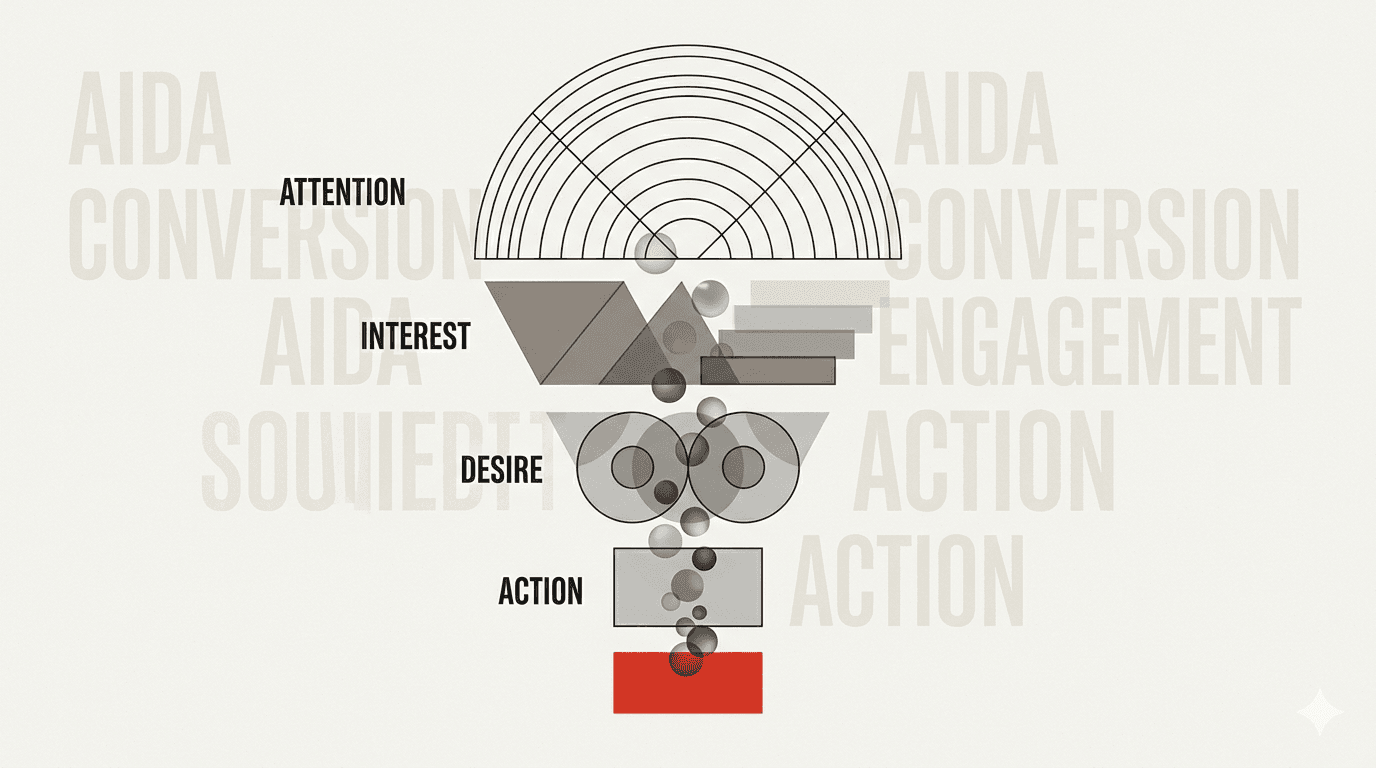
AIDA stands for Attention, Interest, Desire, Action. A copywriting framework invented at the end of the 19th century by an American advertiser. A century later, it remains the foundation of every good sales text. But it needs adapting for today's web.
Why AIDA still works
AIDA works because it follows the natural psychological decision-making process. A visitor doesn't jump straight from "I don't know you" to "I want to buy". They go through stages. AIDA maps them.
What changes with the web is speed. A reader of advertising in a 1900s magazine had time. A web visitor decides in seconds whether to stay or leave.
A · Attention: the first 3 seconds
On a web page, attention is captured in the hero title and subtitle. You have one chance. The title must be specific enough for your target to recognise themselves, and surprising enough to make the visitor want to read on.
What works: identifying a precise problem, promising a concrete result, or asking a rhetorical question that forces reflection.
"A good headline doesn't try to appeal to everyone. It speaks directly to someone."
I · Interest: develop without overwhelming
Once attention is captured, you need to maintain interest. On the web, that means clear visual hierarchy, short paragraphs, lists, and subheadings. No walls of text.
Interest content answers the question: "How does this work?" It might cover your process, your methods, what sets you apart. The goal isn't to sell yet, it's to explain.
D · Desire: inspire with the concrete
Desire is born when the visitor projects themselves forward. They're no longer thinking about your product, they're thinking about what their life will be like with your product. This is where social proof, case studies, and before/after comparisons come in.
- Specific testimonials with measurable results
- Client cases with context and outcomes
- Numbers that speak: "+40% traffic", "delivered in 28 days"
- Visuals of the final result, not the process
A · Action: make the next step obvious
The classic mistake at this stage: a generic CTA and a long form. The visitor who has followed the whole journey is warm. Don't cool them down with unnecessary friction.
One main CTA. Button copy that tells the visitor what they'll receive ("Book my free call", not "Submit"). Micro-copy that removes the last objections. That's it.
AIDA in 2024: what changes
What changes with the modern web is that these four stages are no longer necessarily linear. A visitor might arrive on your page mid-D (they saw a testimonial on LinkedIn). Your page must work regardless of the entry point.
That's why we recommend placing CTAs at multiple points on the page, repeating the value proposition at key moments, and ensuring each section can be read independently.
AIDA is a guide, not a recipe. Adapt it to your audience, your tone, your product. But keep the logic.